
Your log, ready for inspection. Always.
The YACHTWAVE® Commercial Edition. Every entry signed, positioned, time-stamped and tied to the rule it satisfies. When the surveyor says “show me” — you press one button.
Most digital logbooks replace the paper. This one replaces the doubt.
Every entry carries the name of the person who made it and the name of the person who countersigned it. The time the event happened, and separately the time it was written down. The position it happened at. Correct an entry and the original stays — struck through and readable, exactly as the paper convention requires, because in several countries destroying a log entry is a criminal offence rather than a data-quality problem.
Signed and countersigned
Two named people, on every entry that needs one. The countersignatory cannot be the same person as the signatory — because the regulations that matter say so, in as many words.
Provides the record required by UK SI 1981/569 reg. 4 · Malta Merchant Shipping Act (Cap. 234) art. 190(5) · Canada SOR/2007-115 s. 339(5) · Isle of Man MSN 004 ¶1.2.1 — and their equivalents elsewhere in the dataset.
The time it happened, and the time you wrote it
Two timestamps, always. Log an incident at 03:00 and write it up at 07:00 and the record shows both — which is what the rule asks for, and what a single timestamp can never express. We warn you before the deadline to record it closes.
Provides the record required by UK SI 1981/569 reg. 7 · Bahamas Merchant Shipping Act (Ch. 268) s. 143(4) · Isle of Man MSN 004 ¶1.2.2 · Mexico Ley de Navegación y Comercio Marítimos art. 184 fr. I, which allows 24 hours and no more.
Nothing is deleted, and every amendment is on the record
The database rejects a delete on an official log record and the delete endpoint is disabled — an entry that is recorded stays part of the log. Amend it and the amendment writes its own audit record: the action, the person, the time, and the position their device reported. Those audit records cannot themselves be edited or deleted.
Provides the record required by US 46 CFR 140.915(b), which requires every correction to carry “the date and time of entry and name of the person making the correction.”
Every entry knows where it was made
Position captured automatically at the moment of recording, on the entry itself — not in a separate log that ages out.
Provides the record required by Isle of Man MSN 004 ¶1.2.2, which requires the port, or the longitude and latitude, where the occurrence happened on every narrative entry.
Built for the boats that work for a living
Five kinds of operator, one set of obligations underneath. Every regime studied — the ISM Code, US Subchapter M and Subchapter T, the MCA Workboat Code, AMSA Marine Order 504, Transport Canada, ILO C188 — comes back to the same handful of records: drills and training, crew credentials, hours of rest, defects and their close-out, incidents, certificates and survey dates, maintenance evidence, and a log that cannot be quietly rewritten.
Turnarounds measured in minutes
Passenger counts communicated ashore before you sail, a safety briefing logged for every departure, drills on a monthly cadence, and a drydock and certificate calendar that does not depend on anyone remembering.
The deposit dispute you can win
Check-in and check-out condition, photographed and signed at both ends. Guest and crew lists that have to be filed before departure in Croatia and Greece. Coding cycles, charter licences and skipper credentials, all with dates on them.
Ten items, named in the rule
46 CFR 140.915 lists exactly what a towing vessel must record — watch changes, orientation, drills, tests, navigation assessment, towing gear, fire systems — and says the record may be electronic, provided every entry carries a date, a time and a name.
Servicing dates that expire at sea
Liferaft service stickers, hydrostatic releases, EPIRB batteries, immersion suits, flares. Monthly drills. Hour meters on the hydraulics and the refrigeration, not just the main engines. And trips long enough that everything has to work without a signal.
Readiness, on one screen
Municipal police, fire and harbour-master boats, state marine patrols, university research fleets and volunteer rescue services. Pre-underway checks with the mission and the risk score on them, operator currency, and a status the unit can see at a glance.
One product, not five
The labels change, the cadences change, the mandatory fields change. The records do not. That is why this is one Commercial Edition with a regime setting per vessel, rather than five products that each know a little.
The platform underneath the log
A record is only as good as the operation it describes. The Commercial Edition sits on the YACHTWAVE® platform that already runs maintenance, crew and inventory for fleets in 13 languages.
Maintenance & Service Schedules
Hours- and calendar-based schedules on any equipment, with the work that was actually done attached to the machine that had it done.
Equipment & Documents
Every serial number, manual, drawing and certificate on the vessel, in one place, findable by the person standing in front of the machine.
Checklists & Tasks
Standard procedures built once and deployed across the fleet, assigned to a named person and tracked to completion.
Crew & Sharing
Crew assigned to one vessel or many, with role-based access, so the right people see the right boats and nobody else does.
Inventory & Expenses
Spares, consumables and what they cost, counted where they are stowed rather than reconstructed at the end of the season.
Offline Access
Your manuals, schedules, checklists and records stay readable when the signal does not. Saving needs a connection; reading does not.
Your flag. Your vessel. Your actual obligations.
Regulations do not work in feet, and they do not work the same in two countries. A 24-metre charter yacht in Malta, a 20-tonne workboat in the UK and a 15-metre tug in France are governed by three different rulebooks with three different answers about what you must write down and who has to sign it.
Including where the law still requires paper — and we will tell you so. In six territories the statutory log book must still be kept on paper. We know which six, we will name them before you buy rather than after, and we will tell you exactly what we can be for you there instead.
About Log Software Certification
No flag state has approved a maritime logbook app. Not ours, and not anyone else’s — that approval does not exist, and any software claiming to hold it is describing something that is not real. The regulation binds the operator, not the software. What a vendor can honestly hand you is evidence.
So that is what we hand you: exactly which regulation each of your records answers to, in a form a surveyor will accept. And in six countries the law still requires the statutory log book on paper — we will tell you which, before you buy, not after.
This is what it hands the surveyor
Not a description of a record — the record. Every document below is generated live from the log itself, on demand, in one click.
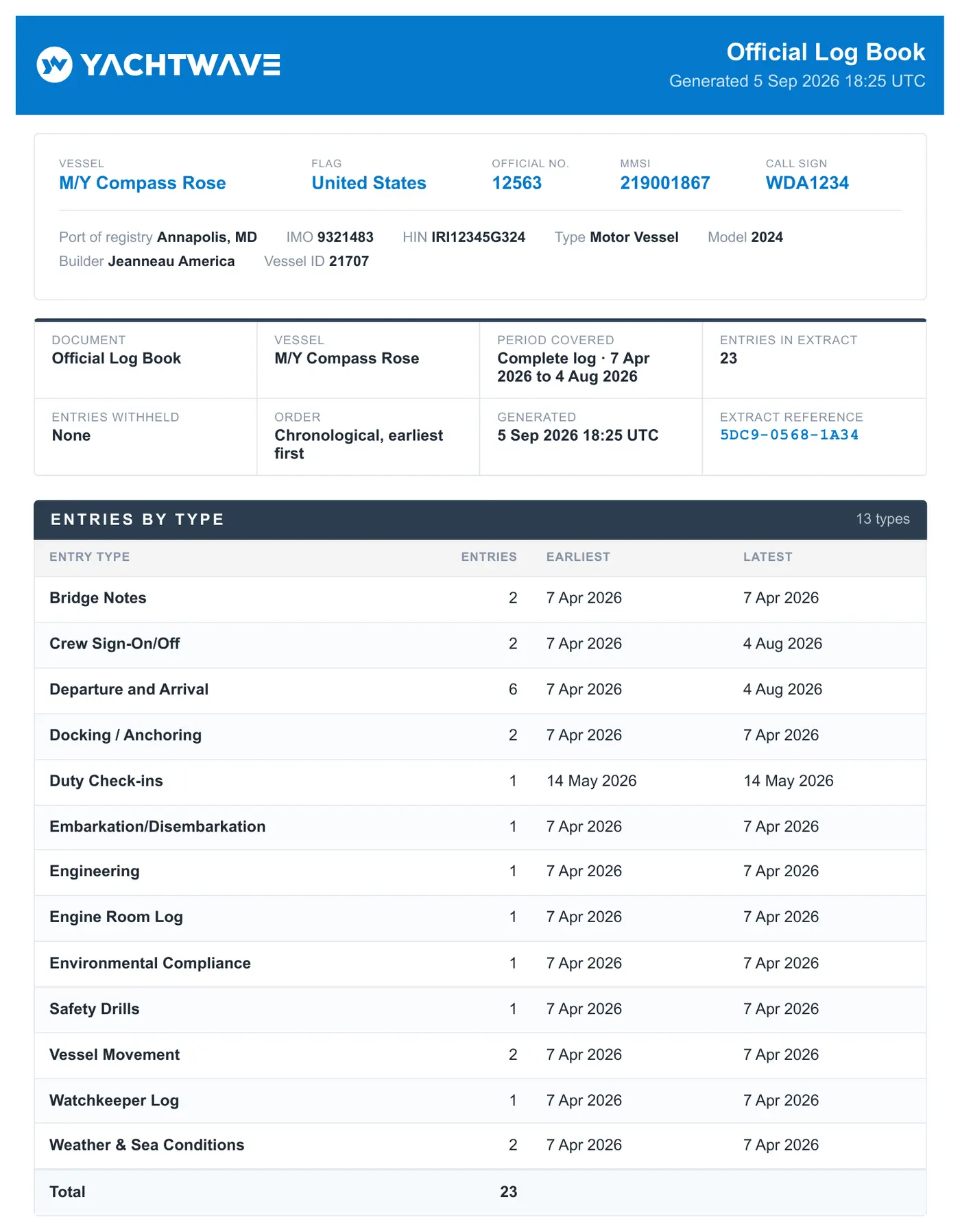
The whole logbook, as one document
The vessel’s registration header — name, flag, official number, MMSI, call sign, port of registry, IMO and HIN — then a document-control block recording the period covered, the number of entries, how many were withheld, and the order they are in.
Underneath it, a breakdown by entry type: bridge notes, crew sign-on/off, departure and arrival, docking, duty check-ins, engine room, environmental compliance, safety drills, watchkeeper. Then every entry itself, oldest first.
Restrict it to a date range when an inspection only covers one, and the document-control block says so on its face.
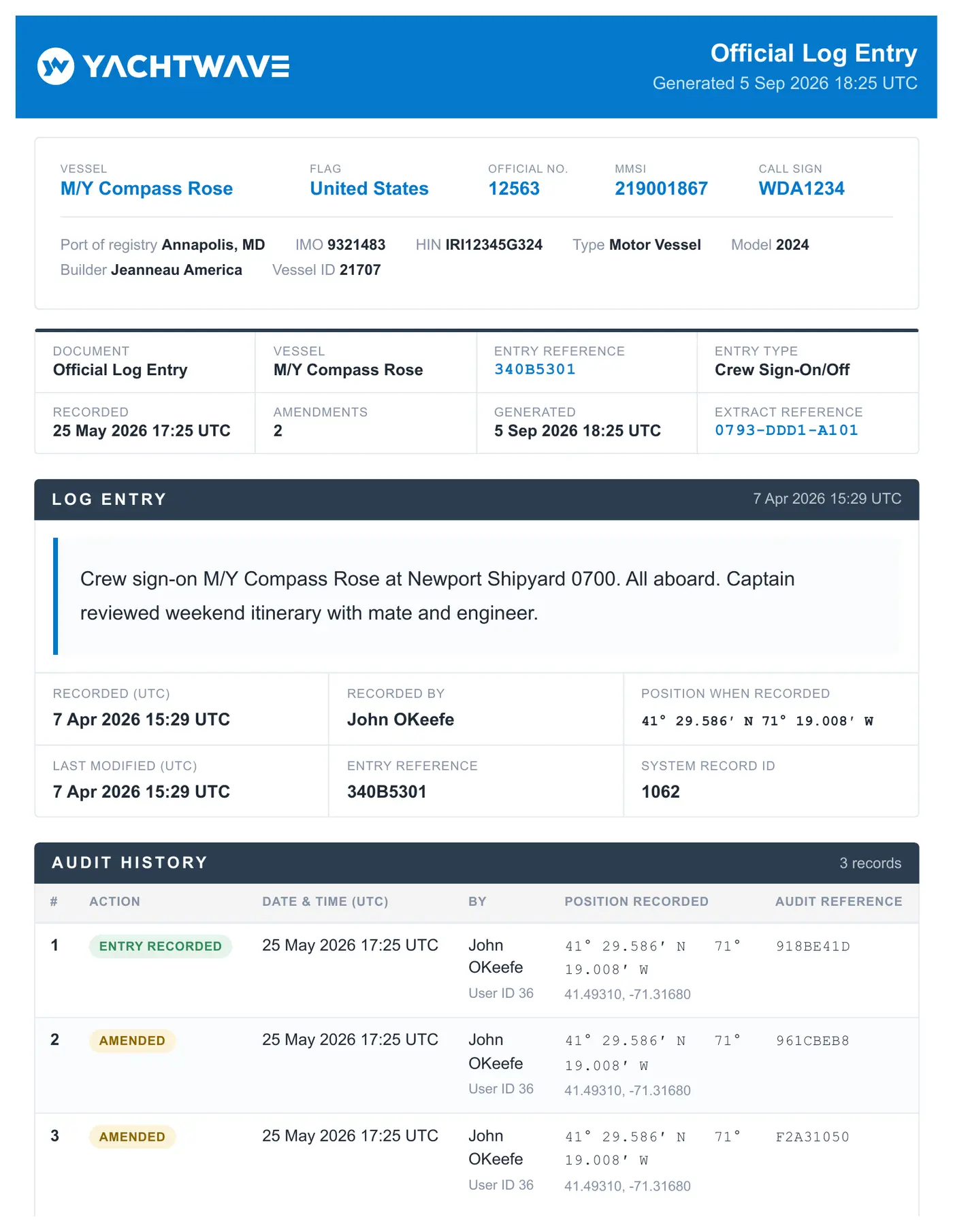
One entry, in full
The entry text, the type it was filed under, who wrote it, the moment it was written in UTC, and the GPS position the device reported at that moment — not a position from a separate track that ages out.
Then the complete audit history of that one entry: every amendment, numbered, with the action, the person and their user ID, the time, and where they were standing when they made it.
Each document carries an extract reference derived from the entries and audit records it contains. The same content produces the same reference; change anything and the reference changes. It is a content reference, not a cryptographic signature, and the report says so in as many words.
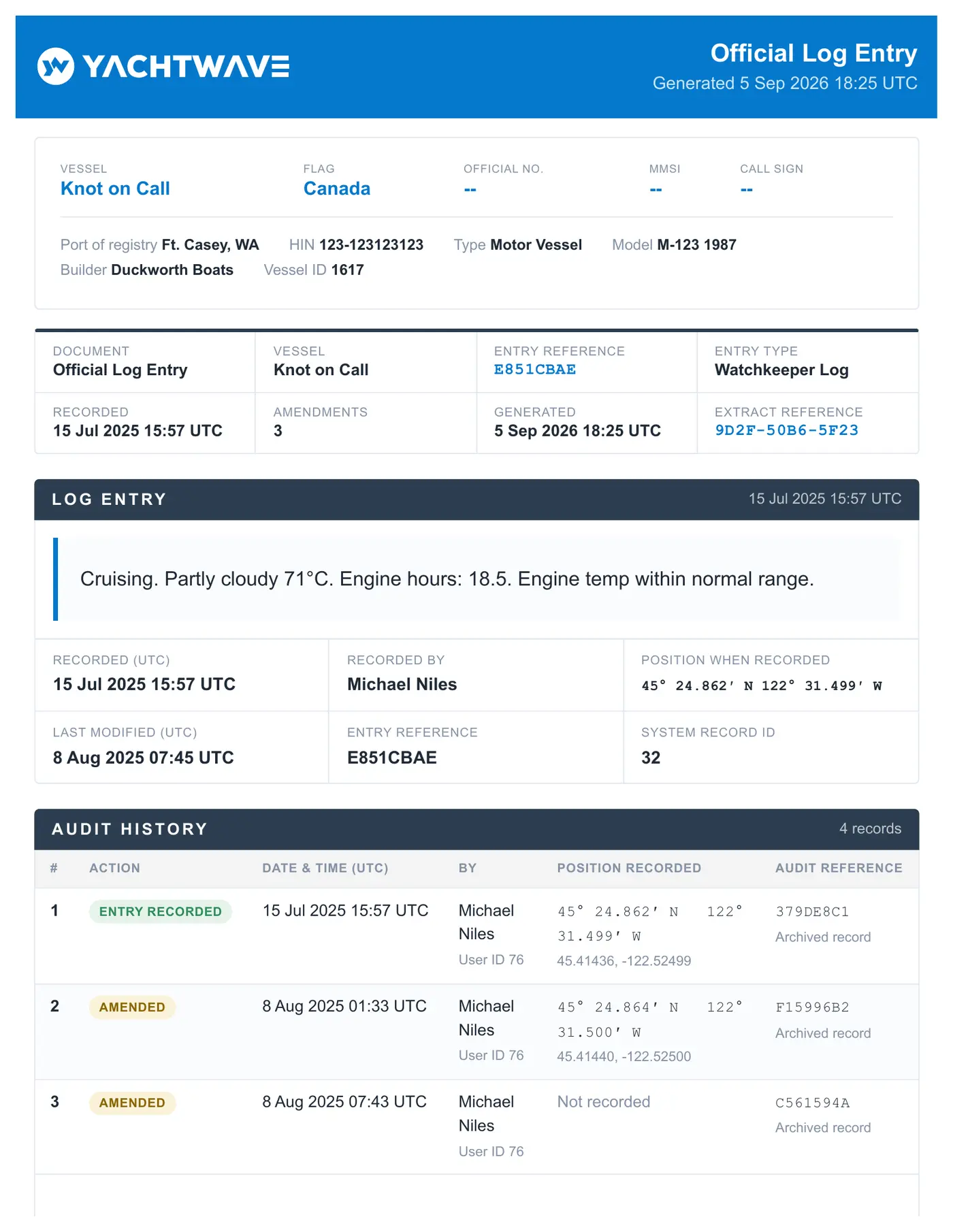
Years on, the history is still there
Audit records older than six months are moved to long-term archive storage by scheduled maintenance. The report reads the archive as well as the live table, so an entry from a previous season produces its full history rather than an empty one, and each archived row is marked as such.
This is the entry an inspection is most likely to ask for — the old one, from the season nobody can remember. A log that quietly shortens its own history the moment the records age is not a log.
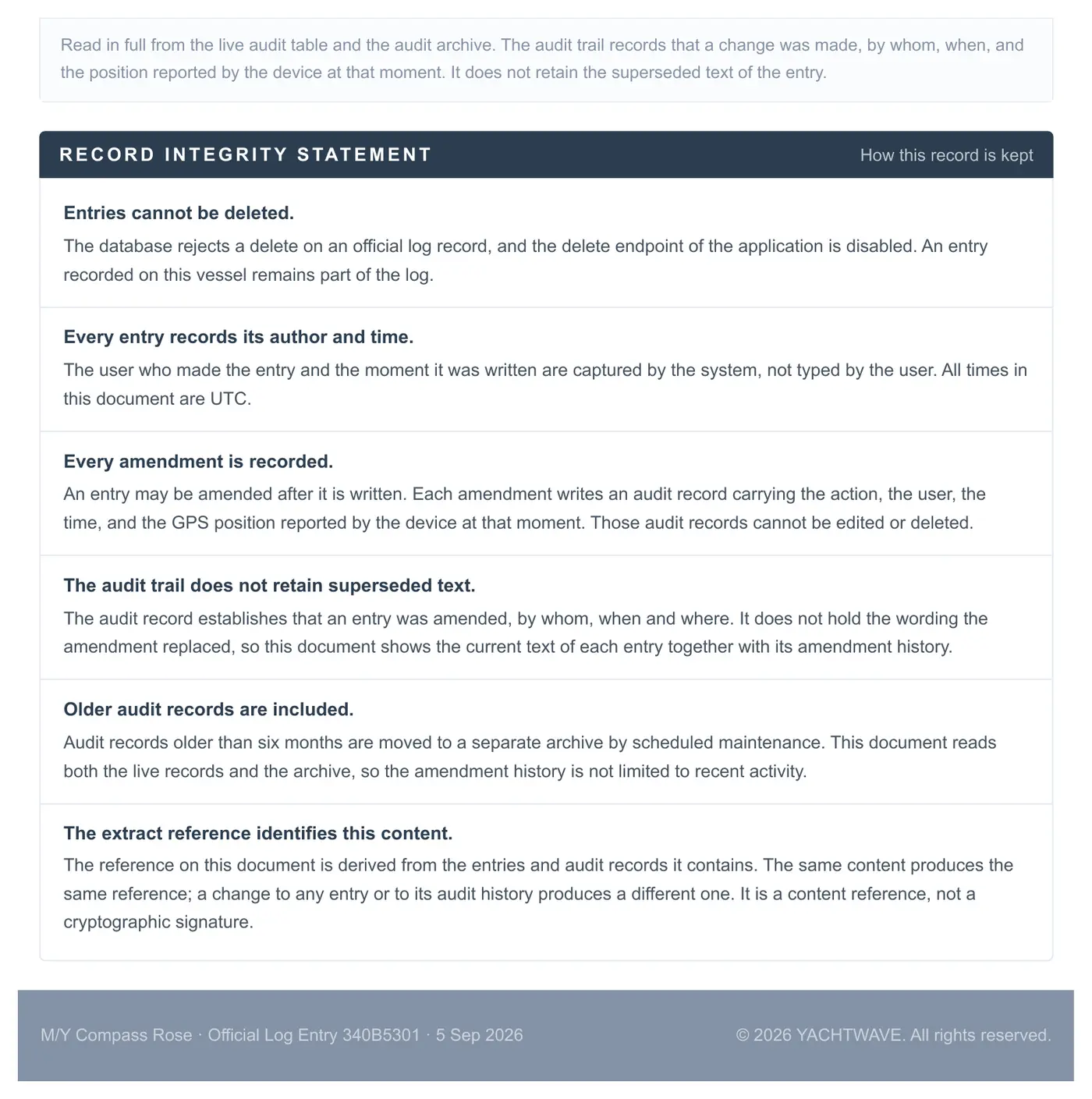
And it tells you how it is kept — including what it does not do
Every report closes with a record-integrity statement: that entries cannot be deleted, that the author and time are captured by the system rather than typed by the user, that every amendment writes an audit record which cannot itself be edited, and that older audit records are read from the archive.
It also states the limit. The audit trail records that an entry was amended, by whom, when and where — it does not retain the wording the amendment replaced. That sentence is on the document a surveyor reads, because a record that overstates itself is worth less than one that does not.
Every Crew Member Reads It in Their Own Language
A drill is only recorded honestly if the person who ran it understood the instruction. YACHTWAVE runs in 13 languages, so the pre-departure check your Greek deckhand opens and the one your Filipino engineer signs off are the same procedure — each read in their own language.
- English (US) English
- Español Spanish
- Français (Canada) French
- Italiano Italian
- Deutsch German
- Português (Brasil) Portuguese
- Dansk Danish
- Nederlands Dutch
- Norsk bokmål Norwegian
- Suomi Finnish
- Svenska Swedish
- Türkçe Turkish
- Ελληνικά Greek
Nothing to set up. YACHTWAVE detects the language your phone or computer already uses and opens in it — each crew member sees the app in their own language from the first screen, without a manager configuring anything per person.
See What Your Flag Requires
Tell us your flag and your vessel, and we will tell you what the law asks you to record — including where it still asks for paper.