
YachtLINK™ NMEA 2000® Marine Gateway
The boat reports in on its own. Engine hours, tank levels, position and system data are read from the vessel's NMEA 2000® network and delivered to your YACHTWAVE® account — with no one typing numbers off a gauge.
The Hour Meter Nobody Wrote Down
Every Maintenance Schedule Is Only as Good as the Last Reading Someone Remembered to Enter
Service intervals are written in engine hours. Tank levels decide whether the charter makes it back. Position is the answer to the only question an owner ever asks. Today all three are typed into an app by whoever happens to be aboard, whenever they happen to remember — and a busy season means they do not. YachtLINK™ reads what the engines and sensors are already broadcasting on the vessel's NMEA 2000® network, and sends it to the YACHTWAVE® app by itself.
One Small Box on a Spare Tee
YachtLINK™ is a small, sealed, fixed-mount gateway. It installs on a spare tee of the vessel's NMEA 2000® backbone with the supplied M12 drop cable, draws its power from the same cable, and connects to the boat's or marina's Wi-Fi to reach the YACHTWAVE® cloud. There is no display to mount, no wiring to run and no port left open on the boat's network.
What It Reads
Whatever the engines, tanks, batteries and instruments already put on the network: engine hours and running data, tank levels, the vessel's position from the boat's own GPS, and whatever else the instruments broadcast. YachtLINK™ listens; it does not take over any instrument or change any setting on the bus.
Where It Goes
Into the vessel's record in YACHTWAVE® — the same place the crew logs maintenance, tickets and cruises today. Engine hours feed the service schedules directly, so the 100-hour service is triggered by the real 100 hours, and the reading history builds a trend for each engine and system without anyone keeping a spreadsheet.
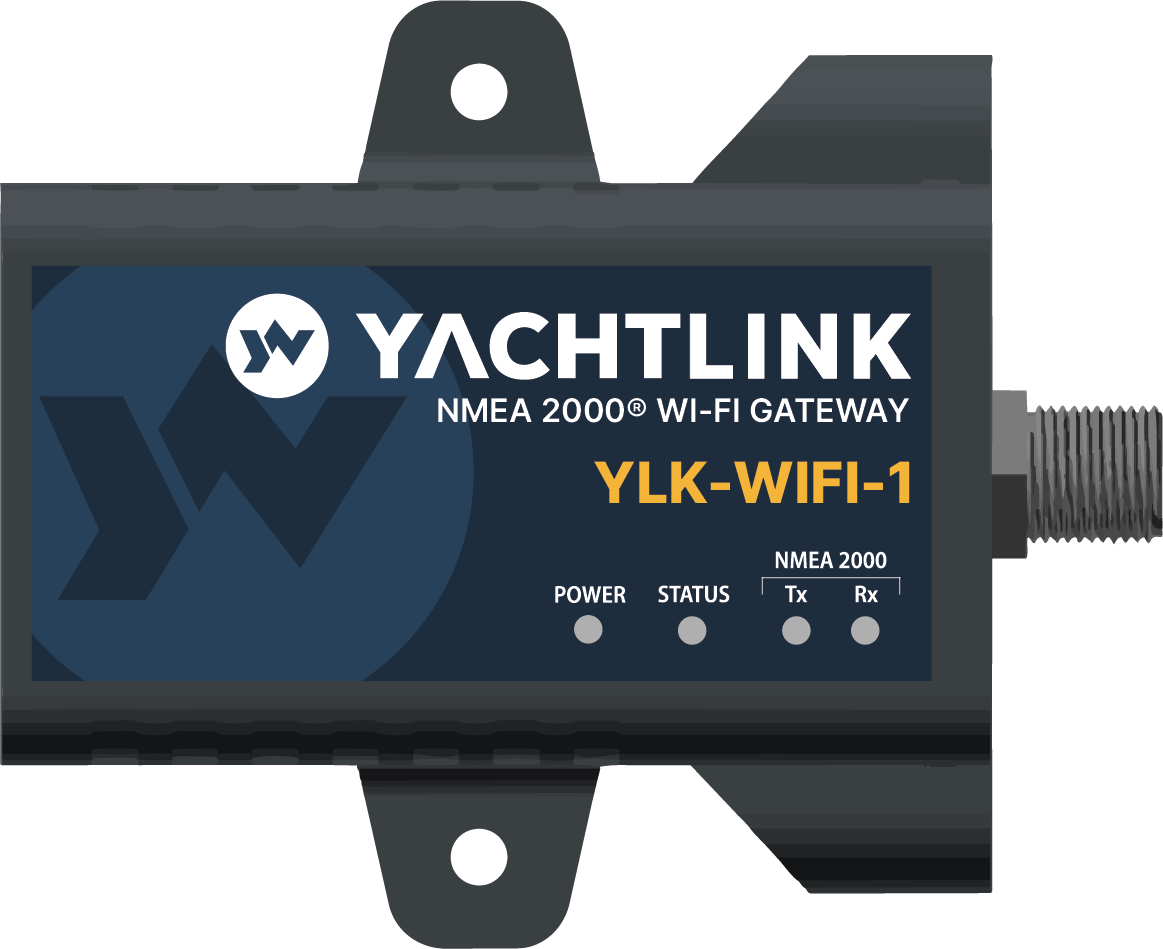
YachtLINK™ | YLK-1-WIFI | NMEA 2000® Marine Gateway
Installed in an Afternoon, Set Up in Five Minutes
No electrician, no separate setup tool, no login on the device itself. If you can join a Wi-Fi network on your phone, you can commission a YachtLINK™ from inside the YACHTWAVE® app.
Nothing to Wire but the Drop Cable
With the network powered down, connect the supplied M12 drop cable between a spare tee and the gateway, mount the unit below deck on its two-hole flange, and power the network back up. The gateway runs on the backbone's 12 V supply and draws no more than a small sensor would.
Setup Happens in the YACHTWAVE® App
At power-up the gateway opens its own Wi-Fi network. Scan the QR code on the unit label, or join the network with the password printed there, then open the YACHTWAVE® app: it finds the gateway, asks which boat or marina Wi-Fi it should use, and links it to the vessel. When the status light goes solid green, data is flowing to your YACHTWAVE® account.
A Password That Is Yours Alone
Every unit leaves the factory with its own Wi-Fi password, printed on the label and never shared with another device. It cannot be reset to a factory default because there is no factory default — a requirement of the UK's product-security law and the EU's radio-equipment cybersecurity standard, and simply good practice on a boat that spends its life on shared marina Wi-Fi.
Keeps Capturing When the Wi-Fi Is Gone
Out of range, the gateway keeps reading the bus and holds what it captures. When the boat is back on its network, the backlog uploads in compressed batches and the record fills in. That capture-and-catch-up design is one of three US patent applications on YachtLINK™ — Patent Pending.
From the Box to Solid Green
- Connect. Network off, drop cable from a spare tee to the gateway's M12 connector, hand-tighten the coupling ring.
- Mount. Below deck, dry location, within Wi-Fi reach of where you will do the setup.
- Power up. Turn the network back on. The status light blinks amber: setup mode.
- Join. Scan the QR code on the label, or join the YachtLINK-… network with the label password.
- Choose a network. Open the YACHTWAVE® app, scan for the boat or marina Wi-Fi, enter its password, connect.
- Done. Solid green. The gateway closes its setup Wi-Fi and runs headlessly from here on.
In the box: the gateway, an M12 drop cable and the Quick-Start Guide. You will need a working NMEA 2000® backbone with a spare tee.
Built for the Engine Room
A sealed box with one connector, designed to be mounted once and forgotten.
Sealed Against Spray and Heat
The enclosure is sealed and rated IPX5 — protected against water jets from any direction — and rated for ambient temperatures up to 65 °C, which is engine-room territory. It is a below-deck device: keep it out of washdown zones and never submerge it.
One Connector, No Loose Ends
The only connection is a standard M12 Micro-C socket for the NMEA 2000® drop cable. Power and data arrive on the same cable. The USB-C port inside the enclosure is for factory programming and is never used in service, and there are no user-serviceable parts — opening the case voids the seal.
A Light Load on the Bus
The gateway declares a Load Equivalency Number of 2 and draws no more than 100 mA, so it fits on an existing backbone without re-planning the power budget. Four lights on the face — power, status, and NMEA 2000® transmit and receive — tell you at a glance what it is doing.
Made in the USA
Made in the USA of domestic and imported materials, by YACHTWAVE® in Sarasota, Florida.
Specifications
- ModelYLK-1-WIFI
- ConnectionNMEA 2000® via M12 Micro-C drop cable
- Power12 V DC from the backbone (9–16 V), 100 mA max, LEN 2
- Wireless2.4 GHz Wi-Fi, IEEE 802.11 b/g/n
- EnclosureSealed, IPX5, below-deck fixed mount
- AmbientUp to 65 °C
- WeightApprox. 113 g (0.25 lb)
- IndicatorsPower, status, NMEA 2000® Tx and Rx
- UpdatesAutomatic over HTTPS, integrity-verified
Bluetooth is present in the radio module but not enabled — YachtLINK™ is a Wi-Fi device only.
Certified, Not Just Claimed
The declarations are signed and published, and the URLs are printed on the box.
NMEA 2000® Certified
YachtLINK™ passed the National Marine Electronics Association's certification programme. The manufacturer and product codes, the Load Equivalency Number and the full lists of transmitted and received PGNs are published on the compliance page, as the certification requires.
NMEA 2000® certification details →
Radio and EMC, Market by Market
FCC and ISED declarations for the United States and Canada are issued. The EU Declaration of Conformity and the UK Declaration of Conformity are signed, together with the UK Product Security statement and the RoHS and REACH declaration. Each one is published in full, with the signed PDF.
Nothing Listening on Your Boat's Network
The gateway is configured over its own Wi-Fi, not over yours. On the boat's or marina's network it makes outbound HTTPS connections to the YACHTWAVE® cloud and listens for nothing. Firmware updates arrive automatically over the same encrypted channel and are verified before they install.
Five Years of Security Updates
The defined security-update support period is five years from the date of sale. Security concerns can be reported through the product-security page.
Regulatory Marks
Contains FCC ID 2AC7Z-ESPS3WROOM1 and IC 21098-ESPS3WROOM1. Three US patent applications filed — Patent Pending. Full status by market, including markets still in progress, is on the compliance hub.
One Gateway, Four Kinds of Boat
The hardware is the same. What it saves you depends on who is waiting for the reading.
Boat Owners
Real engine hours drive the service schedule instead of a guess, and the boat's position and readings are in the app whether you are aboard or at home.
Boat owners →Yacht Managers
Charter boats work hard all season and nobody has time to log hours and tanks by hand. Every vessel in the fleet reports in, and the maintenance schedule keeps itself honest.
Fleet Edition →Vessel Operators
Engine and system readings become the evidence trail behind the working log, with a history per engine that shows a rising temperature before it becomes a breakdown.
Operations Edition →Boat Builders
Installed at the factory, YachtLINK™ tells you how each hull is really used and answers the "where's my boat?" call before it is made. The telematics programme is built around it.
Telematics for boat builders →YachtLINK™ is sold separately and works with the YACHTWAVE® app. Automated readings from the gateway are part of the Ultimate and Operations editions; vessel tracking and telematics is Operations Edition. Boat builders receive it through the telematics programme.
Compare every feature, edition by edition →
Launching Soon
YachtLINK™ is in production. Tell us about your boat or your fleet and we will let you know the moment it ships — and answer the technical questions first.